Key Takeaways
- A smaller, highly engaged email marketing list outperforms a larger, cold one — HubSpot benchmark data shows lists under 1,000 contacts average a 5.9% click-through rate versus 2.9% for lists over 10,000.
- Build your list with lead magnets (guides, templates, checklists), opt-in forms placed at high-intent moments, and a welcome sequence sent within the first 24-48 hours.
- Clean your list every 90 days and suppress non-openers after one final re-engagement attempt — HubSpot found quarterly cleaning cuts bounces by 40% and lifts open rates by 25%.
- Never buy or rent an email list: purchased contacts lack consent under both the CAN-SPAM Act and Australia's Spam Act 2003, and typically damage sender reputation within weeks.
- Target 1-3% net new subscriber growth per month — Campaign Monitor puts the industry median at 1.5%, so anything below 1% means your list is shrinking relative to natural decay.
Never Buy an Email List
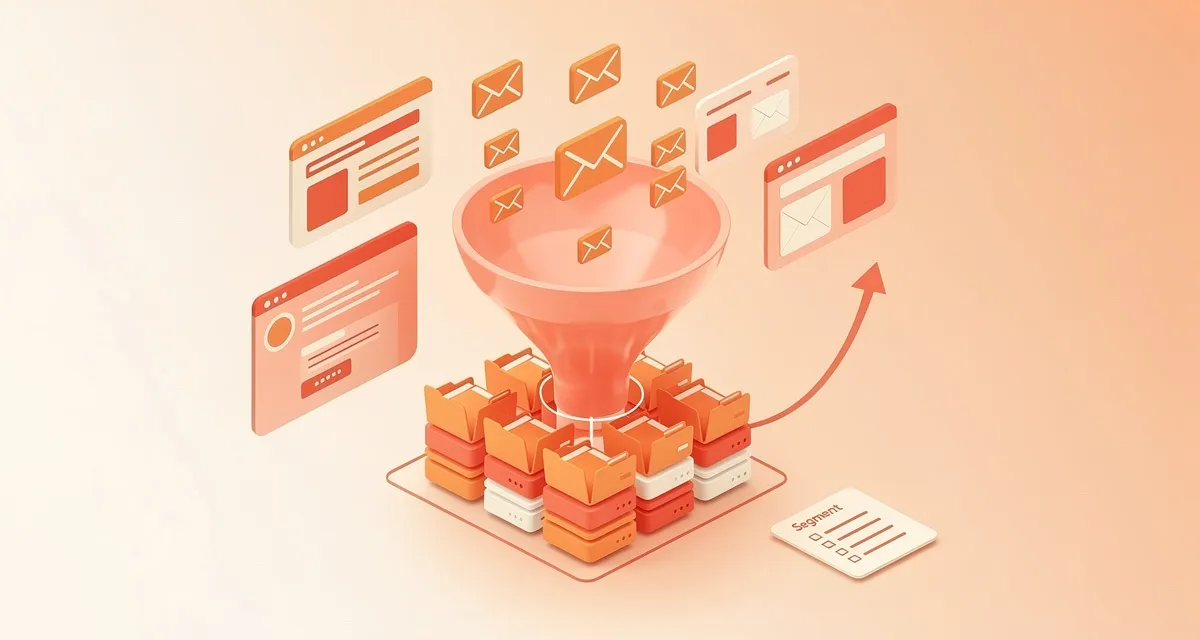
Building an email marketing list that converts starts with a mindset shift: only invest in subscribers who genuinely want to hear from you. A small, engaged list consistently outperforms a bloated, unresponsive one because mailbox providers reward high engagement with better inbox placement. When you prioritize quality, every open and click strengthens your sender reputation, which directly improves future deliverability — a self-reinforcing cycle of better performance and lower cost per result.
GrowthGear sees this pattern across the 50+ startups we’ve advised: teams that treat list building as a deliberate acquisition channel, not a side effect of running campaigns, consistently outperform teams that just import contacts and hope for the best. This guide covers how to build an email marketing list from scratch, how to segment and clean it as it grows, why buying or renting a list is never worth the risk, and which tools and benchmarks separate healthy list growth from expensive list churn.
What Is an Email Marketing List, and Why Does Quality Beat Size?
An email marketing list is a permission-based database of subscribers who have explicitly opted in to receive commercial or promotional messages from your brand, typically via a single or double opt-in process. This definition matters because it separates legitimate email marketing lists from bloated contact databases that lack consent. A list of 1,000 active subscribers can generate more revenue than a list of 10,000 cold contacts, because engagement — opens, clicks, replies — drives both deliverability and conversion.
According to HubSpot’s Email Marketing Benchmarks report, the average click-through rate for lists under 1,000 contacts is 5.9%, while lists over 10,000 see only 2.9%. Quality compounds; size decays.
How List Quality Affects Deliverability and Inbox Placement
Mailbox providers like Gmail, Outlook, and Yahoo use behavioral signals to decide whether your email lands in the inbox or the spam folder. When your list contains inactive or non-consenting addresses, open rates drop and spam complaints rise. Validity — the deliverability firm formed from Return Path — reports that once spam complaint rates cross roughly 0.1%, inbox placement drops sharply, because major mailbox providers weight complaint rate as one of the top-ranked reputation signals in their filtering algorithms.
List quality, measured by engagement recency and consent freshness, is the single most controllable factor in deliverability. Regular list cleaning and re-engagement campaigns are not optional; they are the foundation of a healthy sending reputation.
The Difference Between an Email Marketing List and a General Contact List
A general contact list is any collection of names and addresses — CRM imports, event sign-ups, purchased databases — that lacks explicit consent for ongoing marketing communication. An email marketing list is built specifically for sending promotional email, with subscribers who have freely given permission and can be tracked for engagement. The distinction is legal as well as practical: the CAN-SPAM Act requires every commercial email to include a clear opt-out mechanism, and a contact list with no consent history and no engagement data is a liability, not an asset.
How Do You Build an Email Marketing List From Scratch?
The core building blocks are lead magnets, opt-in forms placed at high-intent moments, and a strong welcome sequence — each designed to attract subscribers who are genuinely interested in your value proposition. Start by identifying the specific problem your ideal customer faces, create a free resource that solves it, place a simple opt-in form where that problem is top-of-mind, then send a welcome sequence that delivers the promised value immediately. According to Litmus research, welcome emails have an average open rate of 82% — more than 4x the typical campaign average — making them the highest-return touchpoint in list building.
Lead Magnets That Convert
An effective lead magnet must be both high-value and low-friction — something the subscriber can use immediately. Gated guides (checklists, whitepapers, industry reports) work well for B2B audiences because they establish authority. Templates (spreadsheets, email sequences, project plans) give subscribers a tangible asset. Calculators (ROI calculators, pricing estimators) drive strong engagement because they require a few inputs and deliver a personalized result. Checklists are low-effort to create and high-utility for the reader. Content Marketing Institute’s B2B research consistently ranks how-to guides and templates among the top-performing lead magnet formats, with roughly seven in ten B2B marketers citing them as their most successful gated content. Match your format to your audience’s immediate need, not to what’s easiest for your team to produce — see our full breakdown of lead magnet ideas ranked by funnel stage and effort for a side-by-side comparison.
Where to Place Opt-In Forms
Placement determines conversion rate as much as the offer itself. The highest-performing locations are:
- Exit-intent popups: trigger when the cursor moves toward the browser’s close button, capturing 3-5% of otherwise lost visitors
- Inline content forms: embedded within a blog post or landing page after the first few paragraphs, where engagement is highest
- Dedicated landing pages: single-purpose pages with no navigation distractions, typically used for gated content or webinars
- Checkout/thank-you pages: a related resource or newsletter offer after a purchase or event registration, where opt-in rates often exceed 20% because trust is already established
Statista reports that the average website conversion rate for email sign-up forms is 2.3%, but top-performing pages reach 10% or more with the right combination of offer and placement.
Growing Your List Through Content and Partnerships
Owned-channel tactics (forms, magnets) only get you so far — pairing them with content and partnership channels compounds growth. Co-hosting a webinar with a complementary (non-competing) business splits the promotion workload and exposes your opt-in form to an audience that already trusts the co-host. Guest posts and podcast appearances work the same way: a strong bio link with a specific lead magnet, not just a generic “visit our website,” converts meaningfully better. Referral incentives — a discount or bonus resource for subscribers who forward your newsletter — tap your existing list to grow itself, typically at a lower cost per subscriber than paid acquisition. Much of this growth work overlaps with your sales team’s own lead generation strategies — coordinating lead magnets and gated content early prevents marketing and sales from building two competing databases of the same prospects.
The Welcome Email Sequence
The first 1-3 emails in your sequence set the tone for the entire subscriber relationship. Send the first email immediately after opt-in: deliver the promised lead magnet, thank the subscriber, and briefly introduce your brand. Follow within 24 hours with a second email offering additional value — a related case study or a quick tip — plus a soft call-to-action. A third email can ask a question or invite a reply. According to Campaign Monitor, welcome emails generate 4x more opens and 5x more clicks than standard campaigns. If you lose engagement here, you rarely recover it later, so invest real effort in clear copy and a single primary goal per email — the same discipline that underpins a strong email newsletter strategy.
Want to scale your marketing impact? GrowthGear has helped 50+ startups build marketing engines that deliver 156% average growth. Book a Free Strategy Session to craft your email list-building roadmap.
How Should You Segment and Clean Your Email List?
Segment your list by engagement recency, lifecycle stage, acquisition source, and firmographic or behavioral data, then clean it every 90 days to remove chronic non-openers and bounced addresses. Segmentation increases open rates by up to 14%, according to Mailchimp’s analysis of campaign performance across its customer base, because subscribers receive messages matched to where they actually are in the relationship. Without a regular hygiene cadence, lists decay by an estimated 22.5% per year according to HubSpot’s list-decay research — roughly one-fifth of your database lost annually to hard bounces, spam traps, and unsubscribes.
Segmentation Criteria That Matter
| Dimension | Example Segments | Why It Matters |
|---|---|---|
| Engagement recency | Opened in last 30 days, last 90 days, 90+ days inactive | High engagement improves deliverability; inactive subscribers drag down metrics |
| Lifecycle stage | New subscriber, lead, MQL, SQL, customer, churned | Tailors content to buying intent and relationship depth |
| Acquisition source | Organic blog, paid ad, webinar, referral | Different channels produce different expectations and behavior |
| Firmographic data | Company size, industry, role | Personalizes product relevance and pain-point messaging |
| Behavioral data | Pages visited, content downloaded, email interactions | Triggers automated sequences based on specific actions |
Start with one or two dimensions and layer on more as your list grows — a targeted email marketing approach depends on this kind of gradual layering. Avoid over-segmenting a small list (under 500 contacts): tiny send groups break the statistical significance you need for reliable testing. For B2B lists, lifecycle-stage segmentation pairs naturally with how your sales team already scores leads — see how to qualify leads using BANT criteria for a compatible framework that keeps marketing and sales segmentation aligned.
List Hygiene and Win-Back Policies
List hygiene means regularly removing hard bounces, spam complaints, and unengaged subscribers on a fixed schedule, not whenever someone remembers to do it. A common rule: suppress contacts who haven’t opened any email in the last 90 days (180 days for longer sales cycles), send one final re-engagement campaign asking directly whether they still want to hear from you, then remove non-responders within 30 days. HubSpot’s benchmark data shows marketers who clean their list quarterly see 40% fewer bounces and 25% higher open rates. A sunset policy isn’t a one-time fix — it belongs on your recurring marketing calendar, not on a someday list. Neglecting this cadence is one of the real reasons teams start to believe email marketing is dead, when the actual problem is an unmaintained list dragging down every send.
Common mistake: Many teams let their sunset policy slip because removing subscribers feels like losing progress. In practice, a list that never sheds cold contacts just costs more per send and drags down the open-rate average that determines your next campaign’s inbox placement.
Should You Ever Buy or Rent an Email List?
No — you should never buy or rent an email list. It violates the consent requirements of the CAN-SPAM Act, damages your sender reputation, and delivers negative ROI compared to organic list building. The Federal Trade Commission requires every commercial email to include a working opt-out mechanism and honor unsubscribe requests promptly, but purchased lists inherently lack the affirmative consent that mailbox providers and regulators expect.
Australian businesses face an equivalent regime under the Spam Act 2003, enforced by the Australian Communications and Media Authority (ACMA), which likewise requires consent, clear sender identification, and a functional unsubscribe link for every commercial email. The compliance logic is the same on both sides of the Pacific: a purchased list cannot satisfy a consent requirement it never obtained in the first place.
What Goes Wrong With Purchased Lists
| Factor | Purchased/Rented List | Organic List |
|---|---|---|
| Consent | None; addresses collected without permission | Explicit opt-in, often double opt-in |
| Spam complaints | Can exceed the 0.1% risk threshold quickly | Well below that threshold on average |
| Spam trap hits | High; purchased lists frequently contain trap addresses | Rare |
| Sender reputation | Degrades within weeks | Builds steadily with engagement |
| ROI | Negative — low opens, high bounces, compliance risk | Positive — higher engagement, stronger conversion |
Even scrubbing a purchased list against a suppression file doesn’t fix the core problem: the addresses were never given with consent for your brand specifically, so the send itself violates CAN-SPAM regardless of how “clean” the list looks technically. The FTC can impose substantial civil penalties per violation — the exact figure is adjusted for inflation each year — and mailbox providers can block your sending domain with no appeals process.
The Build vs. Buy Decision in Practice
| Factor | Organic List Building | Purchased/Rented List |
|---|---|---|
| Time to first results | 1-3 months for initial traction | Immediate, but non-compliant |
| Deliverability risk | Low | Very high |
| Compliance risk | Minimal | High — CAN-SPAM / Spam Act violation |
| Sender reputation trend | Improves with engagement | Degrades on first send |
| Lifetime engagement | Meaningfully higher | Falls to near zero after the first send |
“Every purchased list we’ve seen a client use ends the same way — a spike in spam complaints, a damaged sender score, and months spent rebuilding trust with mailbox providers. The math never works in favor of buying a list; it only ever looks like it will before you press send.” — Andrew Martin, Co-Founder, GrowthGear Consulting
Which Tools and Benchmarks Help You Grow Your List Faster?
The fastest way to grow an email marketing list is to combine ESP-native forms, popup/opt-in tools, landing page builders, and CRM/marketing-automation sync — each solving a different gap in the acquisition funnel. Realistic growth benchmarks for a healthy B2B list run 1-3% net new subscribers per month after churn, with top performers reaching 5% through paid channels and strong lead magnets. Campaign Monitor’s benchmarks put the median organic list growth rate across industries at 1.5% per month — anything below 1% net means your list is shrinking relative to natural decay.
Tool Categories Compared
| Category | Examples | Best For | Starting Price (Monthly) |
|---|---|---|---|
| ESP-native forms | Mailchimp, Constant Contact, ActiveCampaign | Simple sign-up forms on existing templates | $0-$20 |
| Popup/opt-in tools | OptinMonster, Sumo, Privy | Exit-intent, scroll-triggered, and slide-in popups | $9-$29 |
| Landing page builders | Unbounce, Leadpages, Instapage | Dedicated pages for gated content and webinars | $49-$99 |
| CRM/marketing-automation sync | HubSpot, Salesforce, Marketo | Behavioral triggers and cross-team list segmentation | $50-$800+ |
Choose tools that integrate directly with your existing ESP to avoid data silos — a popup tool that pushes leads to your CRM via API is far more reliable than manual CSV imports. Once your list-growth engine is running, pair it with a drip campaign that nurtures new subscribers automatically, and align your segments with a broader B2B email marketing strategy so growth and retention pull in the same direction rather than working against each other.
Summary: Key Steps and Benchmarks
| Step | Key Action | Benchmark / Target |
|---|---|---|
| Lead magnet | Create a high-value, low-friction resource (guide, template, calculator) | ~7 in 10 B2B marketers cite guides/templates as top performers (CMI) |
| Opt-in placement | Add exit-intent popups, inline forms, and dedicated landing pages | Average sign-up conversion: 2.3%; top pages: 10%+ (Statista) |
| Welcome sequence | Send a 3-email sequence within 48 hours of opt-in | Welcome email open rate: 82% (Litmus) |
| Segmentation | Start with engagement recency + lifecycle stage | Up to 14% open-rate lift (Mailchimp) |
| List cleaning | Suppress 90-day non-openers every quarter after one re-engagement attempt | 22.5% annual decay if unmanaged (HubSpot); quarterly cleaning cuts bounces 40% |
| Growth rate | Track net new subscribers per month | Target 1-3% net monthly growth; industry median 1.5% (Campaign Monitor) |
For deeper guidance on the fundamentals underneath all of this, see our email marketing best practices guide.
Grow Your List, Grow Your Business
A high-converting email list isn’t built by accident — it’s the product of deliberate lead magnets, disciplined segmentation, and the discipline to never take a shortcut through a purchased database. Whether you’re starting from zero or cleaning up years of neglected contacts, GrowthGear can help you turn list building into a real growth channel.
Book a Free Strategy Session →
Sources & References
- HubSpot — Email Marketing Statistics and Benchmarks — Benchmark data on click-through rates by list size and quarterly list-cleaning impact on bounce and open rates
- Validity — Email Deliverability Research — Research on spam complaint thresholds and their effect on inbox placement, from the deliverability firm formed from Return Path
- Litmus — State of Email Report — Benchmark data on welcome email open rates relative to standard campaign performance
- Campaign Monitor — Email Marketing Benchmarks — Benchmarks on welcome email performance and industry-wide list growth rates
- Federal Trade Commission — CAN-SPAM Act Compliance Guide — Legal requirements for consent, sender identification, and opt-out mechanisms in commercial email
Frequently Asked Questions
An email marketing list is a permission-based database of subscribers who have explicitly opted in to receive commercial emails from your brand, tracked for engagement to support ongoing sending.
Even 500-1,000 engaged subscribers can generate meaningful revenue if they opted in through a relevant lead magnet — list quality, not size, determines ROI in email marketing.
Buying a list skips affirmative consent, so the first send already violates the CAN-SPAM Act in the US and the Spam Act 2003 in Australia — both require prior permission before commercial email.
Clean your list every 90 days: remove hard bounces immediately and suppress subscribers who haven't opened an email in 90-180 days after one final re-engagement attempt.
A healthy B2B email list grows 1-3% net new subscribers per month after accounting for churn, per Campaign Monitor's benchmarks; top performers reach 5% through paid channels.
How-to guides, templates, and checklists convert best for B2B audiences because they deliver specific value with minimal effort to consume, according to Content Marketing Institute research.
Yes — segmenting by engagement recency, lifecycle stage, and acquisition source lets you send more relevant emails, which Mailchimp's benchmark data links to open-rate lifts of up to 14%.