Key Takeaways
- Marketing funnel automation applies behavior-triggered workflows to each buyer-journey stage — HubSpot reports automated nurturing generates 451% more qualified leads than manual follow-up.
- Automate the mid-funnel first: the nurture stage is where 60 to 70 percent of leads drop off, and it is where automation delivers the fastest measurable ROI.
- A complete stack needs five components — CRM, email platform, landing page builder, analytics, and lead scoring — integrated so data flows from capture through conversion without manual handoffs.
- Gartner reports 53% of marketing spend lacks measurable ROI attribution; funnel automation fixes this by tracking every stage transition and attributing pipeline to specific workflows.
- Start with a 3-workflow system (welcome, nurture, re-engagement), measure stage conversion rates for 30 days, then expand. Teams that automate everything at once spend more time fixing broken workflows than optimizing conversions.
Map Triggers to Funnel Stages Before Building
Marketing funnel automation is the practice of connecting every stage of the buyer journey — from first awareness through conversion and retention — with software-triggered workflows that deliver the right content at the right moment without manual effort. According to HubSpot’s 2024 State of Marketing report, companies using marketing automation generate 451% more qualified leads than those relying on manual processes. Yet Gartner’s CMO Spend Survey found that 53% of marketing spend still lacks measurable ROI attribution — a gap that funnel automation directly closes by tracking every stage transition and attributing pipeline to specific workflows.
This guide covers what marketing funnel automation is, how to build an automated funnel step by step, which stages to automate first, how the leading platforms compare, and how to measure whether your automation is actually generating pipeline rather than just activity.
What Is Marketing Funnel Automation?
Marketing funnel automation is the strategic use of software to trigger personalized content, emails, and sales actions at each stage of the buyer journey based on prospect behavior. It connects your CRM, email platform, landing page builder, and analytics into a system that moves prospects from awareness to conversion through defined, measurable workflow stages.
The distinction from general marketing automation matters. Marketing automation is the software category — tools like HubSpot, ActiveCampaign, and Marketo that can send triggered emails and score leads. Marketing funnel automation is the strategic framework that decides which behaviors trigger which content at which stage, and how each stage transitions to the next. A team can own a marketing automation platform and still have no funnel automation if their workflows are ad hoc rather than stage-mapped. For a deeper comparison of how these systems differ from CRM platforms, see our CRM vs marketing automation guide.
The Five Stages of an Automated Funnel
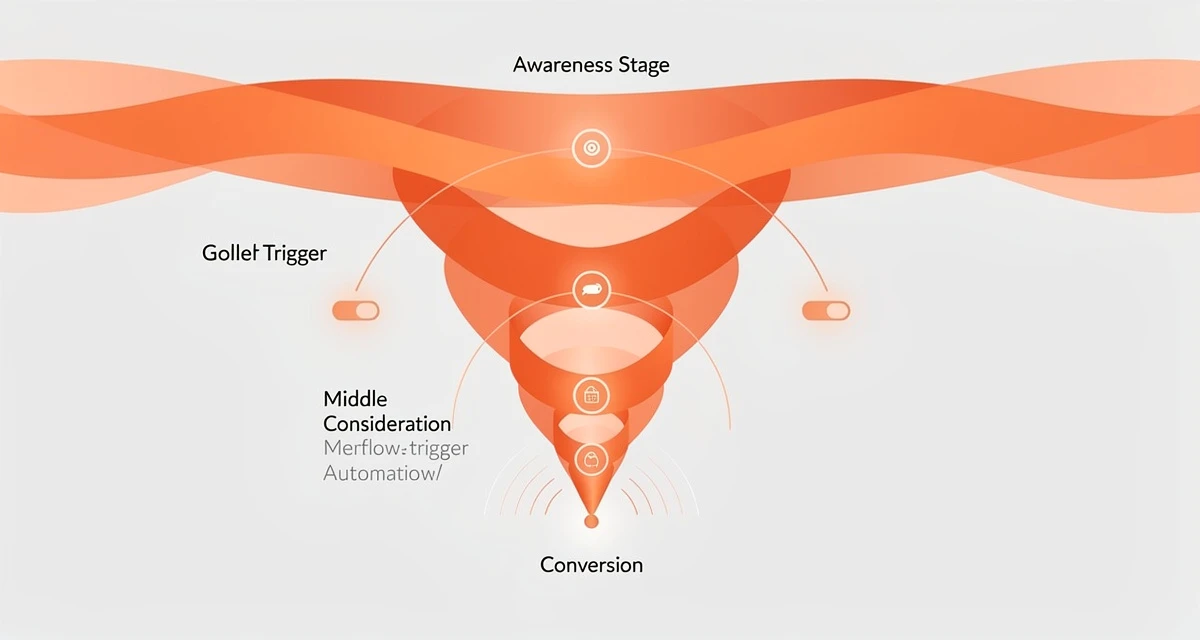
An automated marketing funnel typically has five stages, each with its own trigger, content type, and conversion metric:
| Funnel Stage | Prospect Behavior | Automated Content | Exit Trigger |
|---|---|---|---|
| Awareness | First visit from search, social, or ad | Blog content, lead magnet, popup form | Email capture |
| Engagement | Email signup, content download | Welcome sequence (3-5 emails) | Email 3 opened or clicked |
| Nurture | Repeated visits, pricing page view | Nurture sequence, case studies, comparison guides | Lead score threshold reached |
| Decision | Demo request, trial signup, sales conversation | Trial onboarding, ROI calculator, sales handoff | Opportunity created in CRM |
| Retention | Purchase, onboarding complete | Onboarding sequence, upsell flows, re-engagement | Expansion or renewal |
According to the Content Marketing Institute’s 2024 B2B report, fewer than 40% of marketing teams have a documented funnel framework — which is why so much marketing spend produces traffic but not pipeline. Funnel automation forces the documentation: you cannot build a triggered workflow without defining what triggers it and what happens next.
Why Most Funnels Leak Without Automation
The average B2B buyer interacts with 6 to 8 pieces of content before contacting sales, according to Forrester’s B2B buying journey research. Without automation, each of those touchpoints requires a manual decision: who sees what, when, and what happens after. The result is that most leads fall through the gaps between stages — a prospect downloads an ebook, nobody follows up, and the lead goes cold within 48 hours.
Automation closes those gaps by making the transition between stages automatic. A prospect downloads a guide, which triggers a welcome sequence. They click a link about pricing, which adds 40 points to their lead score. Their score crosses the sales-ready threshold, which creates a task for the sales team in the CRM. Each handoff is defined, tracked, and measurable.
Common mistake: Do not automate a broken funnel. If your awareness-stage content does not convert visitors to email subscribers, automating the nurture stage just sends more content to fewer people. Fix each stage’s conversion rate before wiring it into an automated workflow.
How to Build an Automated Marketing Funnel
Building an automated marketing funnel takes three to four weeks for a basic version and six to eight for a full system with lead scoring and CRM integration. The process starts with stage mapping, moves through trigger definition, builds the technical integration layer, and finishes with testing and calibration.
Step 1: Map Your Funnel Stages and Triggers
Before building any workflow, document each stage of your funnel, the prospect behavior that signals entry to that stage, and the content that should follow. For the foundational funnel model this automation sits on top of, see our digital marketing funnel guide. This trigger-to-stage map is the blueprint for everything else. A typical map looks like:
- Awareness trigger: First website visit from organic search → Content: relevant blog post + lead magnet popup
- Engagement trigger: Email signup → Content: 5-email welcome sequence over 10 days
- Nurture trigger: Lead score reaches 50 points (pricing page visit, repeated content engagement) → Content: case study sequence + comparison guide
- Decision trigger: Demo request form submitted → Content: pre-demo email sequence + sales notification in CRM
- Retention trigger: Purchase completed → Content: onboarding sequence (7 emails over 14 days) + check-in at day 30
According to Salesforce’s State of Marketing report, high-performing marketing teams are 1.6x more likely to have a documented stage-to-trigger map than underperforming teams. The map is not a technical artifact — it is a strategic document that forces alignment between marketing and sales on what constitutes a qualified lead at each stage.
Step 2: Build Your Lead Scoring Model
Lead scoring is the engine that powers stage transitions in an automated funnel. Without it, every lead receives the same content regardless of readiness, and the sales handoff happens manually — or not at all. A lead scoring model assigns point values to prospect behaviors and demographics, and when a lead’s score crosses a defined threshold, automation triggers the next stage.
A practical scoring model for a B2B company:
| Behavior | Points | Why It Matters |
|---|---|---|
| Email signup | +10 | Expressed interest, gave contact info |
| Content download (ebook, whitepaper) | +25 | Higher intent than a newsletter signup |
| Pricing page visit | +40 | Direct commercial intent signal |
| Demo request | +60 | Explicit purchase interest |
| Webinar attendance | +25 | Time investment signals engagement |
| Email click | +5 | Active engagement with content |
| 30 days of inactivity | -10 | Decay prevents stale leads from staying hot |
The sales-ready threshold is typically 80 to 120 points, depending on your sales cycle. When a lead crosses the threshold, automation should create a CRM task for the assigned sales rep with the lead’s full engagement history attached. For B2B-specific automation strategy, including SLA-based sales handoffs, see our B2B marketing automation strategy guide.
Step 3: Build Your Core Workflows
With stages mapped and scoring defined, build three core workflows first. These three cover 80% of the funnel automation value for most teams:
Workflow 1: Welcome Sequence (Engagement Stage) Triggered by email signup. Sends 3-5 emails over 7-10 days introducing the brand, delivering the lead magnet, sharing a customer result, and offering a soft call to action. According to Campaign Monitor, welcome emails generate 4x more opens and 5x more clicks than standard marketing emails — making this the highest-ROI workflow to build first.
Workflow 2: Nurture Sequence (Nurture Stage) Triggered by a lead score of 50 points. Sends 4-6 emails over 3-4 weeks with case studies, comparison guides, and ROI content. Each email includes a soft CTA to book a demo or consultation. The goal is to move leads from “interested” to “evaluating.” For the mechanics of building these sequences, our drip campaign guide covers the email-by-email structure in detail.
Workflow 3: Re-Engagement Sequence (Retention Stage) Triggered by 30 days of inactivity. Sends 2-3 emails attempting to re-engage cold leads with fresh content, a special offer, or a “last chance” message. Leads who do not respond are moved to a lower-frequency communication track to protect deliverability.
Pro tip: Build workflows one at a time, test for 7 days, then build the next. Teams that build all three simultaneously spend weeks debugging broken branches instead of generating pipeline.
Step 4: Integrate Your CRM and Analytics
The final build step connects your automation platform to your CRM and analytics tools so data flows from capture through conversion without manual export-import cycles. According to HubSpot research, companies with tightly integrated CRM and marketing automation see 28% higher revenue growth than those with disconnected systems.
The integration must handle three data flows:
- Lead data: Form submissions create CRM records with full source attribution
- Engagement data: Email opens, clicks, and page visits sync to the CRM contact record
- Stage transitions: When a lead crosses a scoring threshold, the CRM opportunity stage updates automatically
For teams scaling beyond manual CRM management, the Sales Mastery guide on building a sales pipeline from scratch covers how marketing-sourced leads should enter and progress through the sales pipeline. The Sales Mastery guide to B2B lead generation strategies details the outbound and inbound tactics that feed the top of a B2B funnel. AI tools can further reduce the operational cost of maintaining these integrations — the AI Insights guide on implementing AI in business covers practical AI integration patterns for marketing and sales workflows.
Want to scale your marketing impact? GrowthGear has helped 50+ startups build automated funnel systems that deliver 156% average growth. Book a Free Strategy Session to map your automated funnel and identify the workflows that will move pipeline fastest.
Which Funnel Stages Should You Automate First?
The stages you automate first determine how quickly you see ROI. Automating everything at once creates a tangled system that is impossible to debug. Instead, prioritize by impact and ease: the mid-funnel nurture stage is almost always the right starting point. For the strategic framework behind this approach, see our inbound marketing automation guide.
Priority 1: Mid-Funnel Nurture (Weeks 1-3)
The nurture stage is where 60 to 70% of leads drop off in a manual funnel. Prospects have expressed interest but are not yet ready to talk to sales. Without automation, these leads sit in a CRM with no follow-up until they go cold. Automating the nurture stage delivers the fastest ROI because it addresses the largest leak in the funnel.
Build a 4-6 email sequence triggered by lead score reaching 50 points. Content should progress from educational (case studies, how-to guides) to evaluative (comparison guides, ROI calculators) to action-oriented (demo invitation). Each email should have a single CTA. According to the Demand Gen Report, nurtured leads produce 50% more sales-ready leads at 33% lower cost than non-nurtured leads — making this workflow the single highest-ROI automation investment.
Priority 2: Welcome Sequence (Weeks 3-4)
The welcome sequence captures prospects at peak interest — the moment they hand over their email address. A 3-5 email sequence sent over 7-10 days delivers the promised lead magnet, introduces the brand’s value proposition, shares a customer success story, and invites further engagement. Welcome emails have a 4x higher open rate than standard marketing emails, per Campaign Monitor, because the recipient just opted in and is actively expecting your message.
Priority 3: Re-Engagement (Weeks 5-6)
Re-engagement workflows target leads who have gone inactive for 30 days or more. These leads are not lost — they are dormant. A 2-3 email sequence with fresh content, a new offer, or a “we miss you” message can reactivate 10-15% of inactive leads, according to Mailchimp’s email marketing benchmarks. Re-engagement also protects deliverability: removing chronically inactive subscribers from your active list improves sender reputation and inbox placement for all subscribers.
What Not to Automate (Yet)
Two areas resist automation and should remain manual until the core workflows are proven:
Sales conversations: Automation can trigger the handoff, but the conversation itself should be human. According to Forrester, 63% of B2B buyers say the most valuable part of their research was speaking with a sales rep — but only after they had done independent research. Automation prepares the lead; the rep closes the deal.
Top-of-funnel content creation: Automating content distribution is high-ROI. Automating content creation is premature for most teams. AI writing tools can assist with first drafts, but the strategic positioning, original research, and editorial judgment that make content rank and convert still require human writers. For a practical framework on what to automate in content specifically, see our content marketing automation guide.
Stage Automation Priority Matrix
| Funnel Stage | Automation Impact | Implementation Effort | Priority |
|---|---|---|---|
| Nurture | High (fixes 60-70% drop-off) | Medium (4-6 emails + scoring) | 1st |
| Welcome | High (4x open rates) | Low (3-5 emails, simple trigger) | 2nd |
| Re-engagement | Medium (10-15% reactivation) | Low (2-3 emails, time-based trigger) | 3rd |
| Onboarding | Medium (retention impact) | Medium (7+ emails, product-dependent) | 4th |
| Awareness | Low (content is the lever, not automation) | High (SEO, ads, social — not email-triggered) | 5th |
Marketing Funnel Automation Platforms Compared
Choosing the right platform determines how much of your funnel you can automate natively versus how much requires custom integration. The platform should support behavior-triggered email sequences, lead scoring, CRM integration, landing page creation, and stage-by-stage analytics. According to HubSpot, 35% of marketers now use automation for content distribution.
Platform Comparison Matrix
| Platform | Best For | Starting Price | Lead Scoring | CRM Integration | Funnel Workflows |
|---|---|---|---|---|---|
| HubSpot Marketing Hub | SMB to mid-market, all-in-one | $800/mo (Professional) | Advanced | Native (HubSpot CRM) | Full funnel |
| ActiveCampaign | SMB, email-first automation | $49/mo (Plus) | Advanced | Integrations (Salesforce, Pipedrive) | Full funnel |
| Pardot (Salesforce) | Enterprise B2B, Salesforce orgs | $1,250/mo (Growth) | Advanced | Native (Salesforce) | Full funnel |
| Marketo Engage | Enterprise, complex B2B | Custom (typically $3,000+/mo) | Advanced | Integrations | Full funnel |
| Mailchimp | Early-stage, email-focused | $13/mo (Essentials) | Basic | Integrations | Limited (no scoring on Essentials) |
| Klaviyo | Ecommerce, B2C | $20/mo (starter) | Advanced | Integrations (Shopify native) | Full funnel (ecommerce) |
How to Choose
The decision comes down to three factors:
1. CRM alignment. If you already use Salesforce, Pardot is the natural choice because lead data flows natively. If you use HubSpot CRM, Marketing Hub is the obvious pick. If you have no CRM yet, HubSpot’s free tier or ActiveCampaign with a Pipedrive integration covers most SMB needs.
2. Complexity of your funnel. A simple 3-workflow funnel (welcome, nurture, re-engagement) runs fine on ActiveCampaign or Mailchimp. A complex funnel with ABM workflows, multi-branch logic, and sales SLA enforcement needs HubSpot Professional or Pardot. Marketo is reserved for enterprise teams with dedicated marketing operations staff.
3. Team size and technical capacity. HubSpot and ActiveCampaign are designed for marketers, not developers — their visual workflow builders let non-technical team members build and edit automation. Marketo and Pardot require more technical knowledge or a certified consultant for complex builds. For a deeper comparison of HubSpot alternatives that may fit smaller budgets, see our HubSpot alternatives guide.
Pro tip: Start with the platform that matches your current team size, not the one you think you will need in two years. Migrating automation platforms is painful and expensive — but staying on an overbuilt platform that nobody on your team can manage is worse.
Measuring Marketing Funnel Automation ROI
Marketing funnel automation ROI is measured by tracking stage-to-stage conversion rates, cost per qualified lead, marketing-sourced pipeline, and time-to-conversion. The goal is to measure outcomes — leads advanced, pipeline created — not activity. According to Gartner, 53% of marketing spend lacks measurable ROI attribution; funnel automation exists to close that gap.
The Four Metrics That Matter
1. Stage-to-Stage Conversion Rate Track the percentage of leads that advance from one funnel stage to the next. The most critical metric is the nurture-to-SQL conversion rate — the percentage of nurtured leads that become sales-qualified. Before automation, this rate is typically 5-10%. After a well-built nurture workflow, it should reach 15-25% within 90 days. HubSpot reports that companies with automated nurturing see a 451% increase in qualified leads — not because more leads enter the funnel, but because more of them advance through it.
2. Cost Per Qualified Lead (CPQL) Divide total marketing spend (platform costs plus content production plus ad spend) by the number of SQLs generated. According to Demand Gen Report, nurtured leads cost 33% less to convert to SQLs than non-nurtured leads. Track CPQL monthly and benchmark it against industry averages — for B2B SaaS, a CPQL of $50-$200 is typical; for enterprise B2B, $200-$500.
3. Marketing-Sourced Pipeline The total pipeline value of opportunities created directly from automated workflows. This requires CRM integration — when a lead enters the CRM via an automated handoff, the resulting opportunity is tagged as marketing-sourced. According to Forrester’s B2B research, mature automation programs generate 30-50% of total pipeline as marketing-sourced, compared to 10-15% for teams without automation.
4. Time-to-Conversion The average number of days from first touch to closed-won. Forrester reports that mature automation programs reduce the sales cycle by 25 to 35% by delivering the right content at the right moment, eliminating the delays that occur when leads wait for manual follow-up.
ROI Benchmark by Business Stage
| Business Stage | Time to First MQL Lift | CPQL Reduction | Pipeline Improvement |
|---|---|---|---|
| Early-stage startup (< $2M ARR) | 60-90 days | 10-20% | 15-25% |
| Growth-stage SMB ($2M-$20M ARR) | 45-60 days | 20-35% | 25-40% |
| Mid-market ($20M+ ARR) | 30-45 days | 25-40% | 35-55% |
If you’re still weighing whether these numbers justify the investment for your business, see our full breakdown of the benefits of marketing automation, including cost ranges and realistic payback timelines by stage.
The 30-Day Audit
After launching your automated funnel, run a 30-day audit. For each workflow, check:
- Trigger accuracy: Are leads entering the workflow at the right moment? If leads are entering too early or too late, adjust the trigger conditions.
- Email performance: Are open rates above 20% and click rates above 2%? Emails below these thresholds need subject line or content revision. Campaign Monitor benchmarks put the average marketing email open rate at 21.5% across industries.
- Stage transition rate: What percentage of leads advance to the next stage? If fewer than 15% advance, the content is not moving prospects forward — revise the sequence before adding more emails.
- Sales feedback: Are sales reps receiving leads at the right readiness level? If reps say leads are “not ready,” raise the sales-ready score threshold. If they say leads are “already gone,” lower it.
Summary: Marketing Funnel Automation at a Glance
| Element | What It Does | Key Benchmark |
|---|---|---|
| Welcome sequence | Converts email signups to engaged subscribers | 4x open rate vs. standard emails (Campaign Monitor) |
| Lead scoring | Triggers stage transitions and sales handoffs | 80-120 point threshold for sales-ready |
| Nurture workflow | Moves engaged leads toward sales readiness | 50% more SQLs at 33% lower cost (Demand Gen) |
| Re-engagement | Reactivates dormant leads | 10-15% reactivation rate (Mailchimp) |
| CRM integration | Enables attribution and sales handoff | 28% higher revenue growth (HubSpot) |
| Analytics | Measures stage-by-stage ROI | 53% of spend unattributed without it (Gartner) |
Grow Your Brand, Grow Your Business
An automated marketing funnel is not a set-it-and-forget-it system — it is a compounding asset that gets sharper with every workflow you refine and every stage transition you optimize. Whether you are building your first nurture sequence or re-architecting a multi-stage funnel with lead scoring and CRM integration, GrowthGear can help you turn marketing automation into your most reliable pipeline engine.
Book a Free Strategy Session →
Sources & References
- HubSpot, State of Marketing 2024 — “Companies using marketing automation generate 451% more qualified leads; 35% of marketers use automation for content distribution” (2024)
- Gartner, CMO Spend Survey 2023 — “53% of marketing spend lacks measurable ROI attribution; marketing budgets average 9.1% of revenue” (2023)
- Forrester, The B2B Buying Journey — “B2B buyers interact with 6-8 content pieces before contacting sales; 63% say speaking with a rep was the most valuable research step; mature automation reduces sales cycle by 25-35%” (2024)
- Content Marketing Institute, 2024 B2B Content Marketing Report — “Fewer than 40% of B2B marketers have a documented marketing plan” (2024)
- Demand Gen Report — “Nurtured leads produce 50% more sales-ready leads at 33% lower cost” (2024)
- Salesforce, State of Marketing 2024 — “High-performing teams are 1.6x more likely to have documented stage-to-trigger maps” (2024)
- Campaign Monitor, Email Marketing Benchmarks — “Welcome emails generate 4x opens and 5x clicks; average open rate is 21.5%” (2024)
- Mailchimp, Email Marketing Benchmarks — “Re-engagement campaigns reactivate 10-15% of inactive subscribers” (2024)
Frequently Asked Questions
Marketing funnel automation is the practice of using software to trigger personalized content, emails, and actions at each stage of the buyer journey — from first awareness through conversion and retention — without manual intervention at every touchpoint.
Marketing automation is the broad software category covering email sequences, lead scoring, and CRM routing. Marketing funnel automation is the strategic application of those tools specifically to move prospects through funnel stages with stage-appropriate triggers and content.
Start with the mid-funnel nurture stage. According to HubSpot, companies that automate lead nurturing generate 451% more qualified leads. Mid-funnel automation delivers the fastest ROI because it addresses the stage where most prospects drop off.
Entry-level platforms like ActiveCampaign and Mailchimp start at $15 to $49 per month. Mid-market tools like HubSpot Professional run $800 to $3,600 per month. Enterprise platforms like Marketo and Pardot exceed $1,250 per month plus implementation costs.
A complete stack includes a CRM for lead data, an email platform for triggered sequences, a landing page builder for lead capture, an analytics tool for stage-by-stage measurement, and optionally a lead scoring engine to trigger sales handoffs.
A basic automated funnel with lead capture, a welcome sequence, and one nurture flow takes 3 to 4 weeks. A full multi-stage system with lead scoring, CRM integration, and 3+ nurture sequences typically takes 6 to 8 weeks to build and calibrate.
Track stage-to-stage conversion rates, cost per qualified lead, marketing-sourced pipeline, and time-to-conversion. Compare these metrics before and after automation. According to Forrester, mature automation programs reduce the sales cycle by 25 to 35 percent.