Key Takeaways
- An AI marketing agent autonomously plans and executes multi-step tasks like ad-bid optimization or content tagging, unlike a chatbot or AI-assisted tool that still needs a human to act on its output.
- 86.4% of marketing teams already use AI in at least a few marketing areas, but most of that is still AI-assisted rather than fully autonomous agent use (HubSpot 2026 State of Marketing).
- Start with one narrow, high-volume task — like ad-bid optimization or content tagging — with human-in-the-loop review for the first 60-90 days before expanding scope.
- Set a kill criterion before piloting an AI marketing agent: Gartner predicts over 40% of agentic AI projects will be canceled by 2027 over unclear ROI.
- Gartner predicts 60% of brands will use agentic AI for one-to-one marketing interactions by 2028 — put spend limits, audit logs, and human approval in place before scaling past a pilot.
Scope the Pilot Before You Scale
Marketers keep hearing that “AI agents” are about to change how campaigns get run, but the term gets applied to everything from a smarter content-drafting assistant to a system that autonomously reallocates ad spend in real time. The distinction matters because it determines what you’re actually buying, how much oversight it needs, and what happens when it gets something wrong.
HubSpot’s 2026 State of Marketing report, based on a survey of over 1,500 global marketers, found that 86.4% of marketing teams now use AI in at least a few marketing areas — but the same report found 73.4% still describe that AI as working in conjunction with them, assisting rather than acting on its own. Adoption of AI-assisted tools is nearly universal; true autonomous agents are still the exception.
This guide gives you a working definition, walks through how these systems actually operate inside a marketing stack, and lays out a practical build-vs-buy and pilot framework.
What Is an AI Marketing Agent?
An AI marketing agent is software built on a large language model that autonomously plans and executes multi-step marketing tasks — drafting a content calendar, running an ad-optimization loop, or personalizing a campaign — without a human directing each step. It perceives data, reasons about the next best action, and acts through connected tools to reach a defined goal.
This definition matters because “AI agent” is often misapplied to broader categories of software. To place it correctly in your stack, distinguish it from three common alternatives:
- Chatbots: Typically single-turn Q&A interfaces. They answer a question and stop, with no plan for a sequence of actions and no memory of “doing” anything beyond talking.
- Traditional marketing automation and RPA: Rely on fixed, rule-based workflows. If a variable changes unexpectedly, such as a sudden drop in ad performance, the rigid script breaks or produces irrelevant output.
- AI-assisted tools: Writing assistants and image generators require a human to initiate the task, review the output, and manually execute the next step. The human stays the driver; the AI is a co-pilot.
The distinction is in the decision-making architecture. Anthropic’s engineering team, which builds and studies these systems directly, draws the sharpest version of this line in its research on agent design:
“Workflows are systems where LLMs and tools are orchestrated through predefined code paths. Agents, on the other hand, are systems where LLMs dynamically direct their own processes and tool usage, maintaining control over how they accomplish tasks.” — Anthropic, “Building Effective Agents”
That distinction is the one to hold onto when a vendor tells you their product is “agentic.” A workflow tool that calls an LLM at a fixed step in a predefined pipeline is not the same thing as a system that decides, on its own, which steps to take next.
Why does this matter for your budget and org chart? Because autonomy changes the operating model. A writing assistant still needs a marketer to brief it, review the draft, and hit publish — the headcount math doesn’t change much. An agent that monitors an ad account and reallocates budget on its own shifts that marketer’s job from executing the reallocation to reviewing and auditing it, which is a genuinely different skill set to hire and manage for. For the underlying mechanics that apply across every business function, not just marketing, see what an AI agent is and how it differs from a chatbot or RPA.
How AI Marketing Agents Work
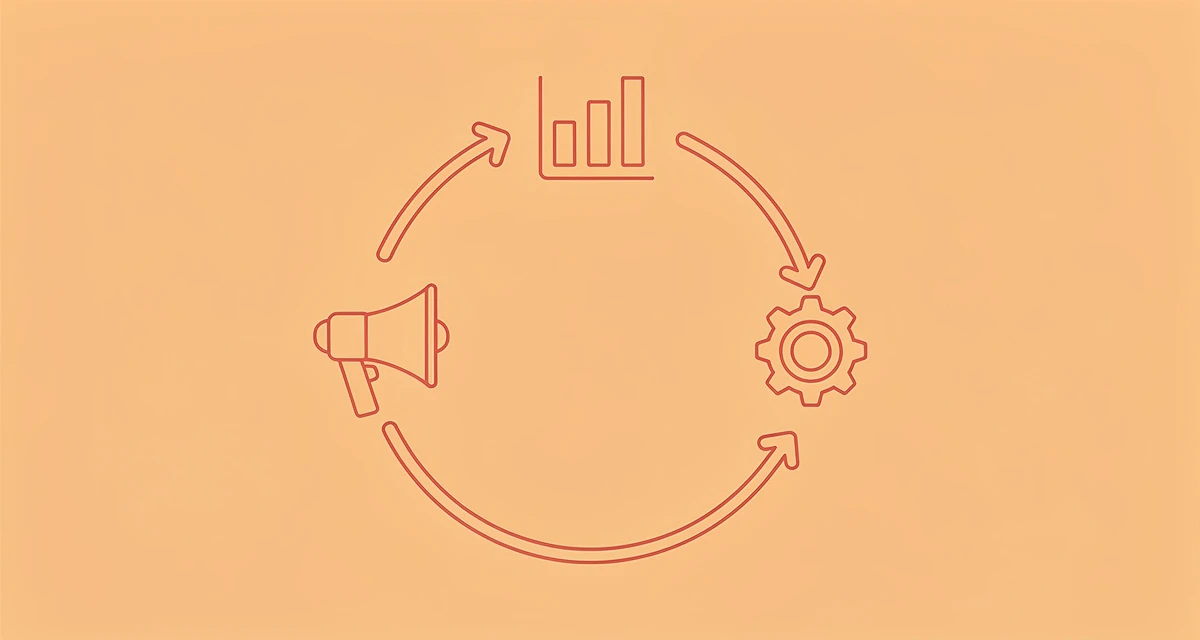
An AI marketing agent runs a loop: it perceives its environment, reasons about the next move, acts through a connected tool, and observes the result before deciding whether to act again. It repeats this cycle continuously, adjusting to new data without constant human intervention.
The Perceive-Reason-Act Loop
Consider an agent tasked with the goal “keep this ad campaign’s CPA under $50”:
- Perceive: The agent pulls real-time data from the ad platform API — current spend, conversion rates by creative variant, and pacing against budget.
- Reason: It determines that “Creative B” is underperforming relative to “Creative A” and concludes that shifting budget toward A will lower blended CPA.
- Act: It calls the ad platform API to reallocate spend.
- Loop: It waits for the next data refresh, perceives the updated results, and repeats.
This loop lets the agent react to performance shifts in minutes rather than the hours or days it typically takes a human to notice a dip and manually adjust.
Tool Use and Function Calling
An agent is only as useful as the tools it can call. Through function calling, the LLM invokes a defined API to take an action outside its own text generation — and receives the result back as new context. A marketing agent’s typical tool set includes:
- CMS/publishing APIs, to draft, schedule, or publish content.
- Ad platform APIs, to adjust bids, pause underperforming ads, or build new audiences.
- Analytics/BI tools, to pull performance metrics and calculate ROI.
- Email/ESP systems, to segment lists and trigger personalized sends.
- Social schedulers, to post content and monitor engagement.
Function calling is what turns the model from a text generator into an action engine — building on the same class of AI marketing tools most teams already use for narrower, human-directed tasks, just with the human review step removed from the loop.
Memory: Campaign History and Segment Context
Short-term memory is just the running context an agent holds during one loop — the current campaign’s spend and performance data. Long-term memory means the agent can pull in history it wasn’t directly told about: last quarter’s creative performance, a segment’s past purchase behavior, or brand guidelines stored outside the immediate conversation. Most production marketing agents pair a short-term working context with a retrieval layer over your CRM or content library, so a personalization agent can pull a customer’s history rather than treating every interaction as a blank slate.
Single Agent vs. Multi-Agent Systems
Marketers often picture complex, multi-agent ecosystems — one agent researching, another drafting, a third editing. That’s a real architecture, but it adds coordination overhead and more places for something to go wrong.
- Single agent: Scoped to one task, like “optimize Facebook ad bids.” Easier to debug, monitor, and control, with a clear goal and a defined tool set.
- Multi-agent systems: Multiple agents coordinated by a supervisor, useful for complex pipelines like end-to-end content production, but errors in one agent can cascade and are harder to trace.
Most marketing teams evaluating their first deployment should start with a single agent scoped to one high-value task before attempting to orchestrate several.
AI Marketing Agents vs. Marketing Automation, Chatbots, and AI-Assisted Tools
The right technology depends on the shape of the task, not the hype around it. AI marketing agents fit dynamic, unpredictable workflows where the number of steps can’t be known in advance; marketing automation, chatbots, and AI-assisted tools remain the better, cheaper choice for anything with a fixed, known sequence.
| Approach | How it decides what to do | Handles novel situations? | Typical marketing use case | Common failure mode |
|---|---|---|---|---|
| AI marketing agent | LLM dynamically plans and selects tools based on real-time data | Yes, adapts to new inputs | Ad-bid optimization, dynamic personalization | Hallucination leading to an incorrect API call |
| Chatbot | Predefined intent recognition or single-turn LLM response | No, limited to trained queries | Customer support FAQ, lead qualification | Fails on a question outside its training |
| Marketing automation/RPA | Fixed rule-based workflow (if X, then Y) | No, breaks on unexpected variables | Drip email sequences, lead scoring | Rigid logic fails when a data format changes |
| AI-assisted tool | Human initiates and reviews each output | N/A, human makes the final call | Copywriting, image generation, data analysis | Human bottleneck slows execution |
The practical buyer takeaway: if a task has a genuinely unpredictable number of steps, such as reacting to real-time ad performance or shifting inventory levels, an agent fits. If the steps are fixed and known, like sending a welcome email three days after signup, a well-built marketing automation program is cheaper, more auditable, and won’t hallucinate a wrong action.
Want to scale your marketing impact? GrowthGear has helped 50+ startups build marketing engines that deliver 156% average growth. Book a Free Strategy Session to craft your marketing roadmap.
Where Marketing Teams Are Already Using AI Agents
Adoption is moving from experimentation toward early production use. HubSpot’s 2026 State of Marketing report found that 86.4% of marketing teams now use AI in at least a few marketing areas, and while most of that remains AI-assisted, forward-leaning teams are piloting true agents in three areas.
Content Operations
Content teams use agents to handle the mechanical heavy lifting of production. Rather than writing every word from scratch, a marketer supplies a brief and the agent:
- Drafts first-pass content by pulling from brand guidelines and previously high-performing assets.
- Tags and routes assets to the right editor or reviewer based on topic and tone.
- Repurposes long-form content into social formats, generating post drafts and email summaries automatically.
This doesn’t replace the human creative voice — it accelerates the assembly and distribution work around it. For the workflow layer underneath agent-drafted content, see our content marketing automation guide.
Campaign and Ad Optimization
Performance teams deploy agents to manage bid strategy and budget allocation in place of a daily manual review. These agents monitor spend continuously and:
- Shift budget toward better-performing channels or creative variants automatically.
- Flag underperforming spend for human review, with a stated rationale for the recommendation.
- Adjust targeting parameters against daily conversion data to hold a CPA target.
Personalization at Scale
Marketers connect agents to CRM and CDP data to move beyond static segmentation. These agents can assemble a personalized email or landing page variant per segment or account, select product recommendations from recent browsing behavior, and adjust messaging tone by lifecycle stage — a level of one-to-one output that was previously impossible to produce manually at volume. The same shift is happening one stage further down the funnel — see what an AI sales agent is and how sales teams are piloting one.
Gartner’s January 2026 forecast predicts that 60% of brands will use agentic AI to deliver streamlined one-to-one interactions by 2028. Gartner senior principal researcher Emily Weiss framed the scale of that shift bluntly: “This marks the end of channel-based marketing as we know it.” Separately, Gartner’s enterprise-software forecast puts a nearer-term number on the trend: 40% of enterprise applications will carry a task-specific agent by the end of 2026, up from under 5% in 2025.
Build vs. Buy: Evaluating and Piloting Your First AI Marketing Agent
Most marketing teams should buy or adopt a vendor’s pre-built agent for well-defined, high-volume tasks like ad-bid optimization, and reserve custom builds for workflows that are genuinely proprietary and uncovered by any vendor. Either way, start with one narrow, measurable pilot before expanding scope.
Why Most Agentic AI Pilots Still Fail
Gartner predicts that over 40% of agentic AI projects will be canceled by the end of 2027, citing escalating costs, unclear business value, and inadequate risk controls as the leading causes. Agents aren’t “set and forget” systems — without careful scoping and continuous monitoring, they can drift, run up unexpected API costs, or take an action that damages brand reputation before anyone notices.
A Five-Step Evaluation Framework for Marketing Leaders
- Define the goal and success metric first. State the specific outcome, like “reduce CPA by 10%,” before evaluating any vendor.
- Pick one narrow, high-volume task. Ad-bid optimization or content tagging are proven starting points; avoid trying to automate an entire content calendar or multi-channel strategy on day one.
- Set human-in-the-loop review for the first 60-90 days. Require approval before the agent’s actions go live, then relax the checkpoint only once accuracy is proven.
- Evaluate vendors on tool breadth and observability, not just model quality. Ask what tools the agent can call and whether every action is logged for audit.
- Set a kill criterion before launch. Decide up front what result would make you shut the pilot down — the step Gartner’s cancellation data suggests most failed projects skipped.
Many teams start by asking whether the person who already owns this workflow, often a marketing automation specialist, can also own agent oversight, rather than hiring a new role from scratch.
Typical Costs and Timelines
Vendor-managed agents for well-defined tasks like ad-bid optimization typically launch as a paid pilot within a few weeks, since the vendor has already built the integrations and guardrails — your team is mainly configuring it to your accounts and approval rules. Custom-built agents take materially longer because your team has to build and test the tool integrations, memory layer, and audit logging from scratch, which is the main reason Gartner’s cancellation forecast skews toward projects with unclear scope. This mirrors the broader framework for implementing AI in business, just scoped down to marketing workflows specifically.
Governance and Guardrails for Marketing Agents
Autonomy without guardrails is where pilots turn into incidents. Every production marketing agent needs:
- Scoped permissions: don’t give a content agent standing publish authority without review — limit it to draft or preview mode until accuracy is proven.
- Spend and rate limits: any agent touching ad budget needs a hard daily cap and rate limit to prevent runaway costs.
- Audit logs: the agent should record every action it takes, including the reasoning behind each decision, for debugging and compliance.
- Human approval: require sign-off before anything goes live to customers or spends money.
AI Marketing Agent Decision Summary
| Decision point | Choose “buy” when… | Choose “build” when… |
|---|---|---|
| Task definition | Standardized and well-defined across the industry | Genuinely unique to your proprietary data or process |
| Volume | You need to deploy across multiple teams or channels quickly | You’re testing one experimental, low-volume workflow |
| Time to value | You need results within weeks | You have engineering capacity for a longer ramp-up |
| Risk tolerance | You’re comfortable relying on vendor security and compliance | You need full control over data privacy and model behavior |
| Cost profile | You prefer predictable subscription pricing | Usage is high enough that per-seat pricing gets expensive |
Grow Your Brand, Grow Your Business
A winning marketing strategy doesn’t happen by accident. Whether you’re building your first content engine or optimizing a multi-channel campaign, GrowthGear can help you turn marketing into your strongest growth lever.
Book a Free Strategy Session →
Sources & References
- Anthropic, “Building Effective Agents” — “Workflows are systems where LLMs and tools are orchestrated through predefined code paths. Agents…dynamically direct their own processes and tool usage” (2024)
- HubSpot, 2026 State of Marketing — 86.4% of marketing teams use AI in at least a few marketing areas; 73.4% describe AI as working in conjunction with them rather than autonomously (2026)
- Gartner — “60% of brands will use agentic AI to deliver streamlined one-to-one interactions” by 2028; analyst Emily Weiss: “This marks the end of channel-based marketing as we know it” (2026)
- Gartner — “40% of enterprise applications will feature task-specific AI agents by the end of 2026, up from less than 5% in 2025” (2025)
- Gartner — “Over 40% of agentic AI projects will be canceled by the end of 2027” citing cost, unclear value, and risk controls (2025)
Frequently Asked Questions
An AI marketing agent is software built on a large language model that autonomously plans and executes multi-step marketing tasks, such as ad-bid optimization or content tagging, without a human directing each step.
A chatbot answers one question at a time in a single turn. An AI marketing agent plans a sequence of actions and keeps working toward a goal, like lowering a campaign's CPA, across multiple steps.
Marketing automation follows a fixed, pre-programmed sequence that breaks when something unexpected happens. An AI marketing agent reasons about the goal and adapts its next move when conditions change.
Buy a vendor's pre-built agent for well-defined, high-volume tasks like ad-bid optimization. Only build a custom agent when your workflow is proprietary and no vendor covers it.
The top risks are the agent taking a costly or brand-damaging action without review, unclear audit trails, and scope creep past the pilot. Gartner expects over 40% of agentic AI projects to be canceled by 2027 over unclear ROI.
HubSpot's 2026 State of Marketing report found 86.4% of marketing teams use AI in at least a few marketing areas, though most of that use today is AI-assisted rather than fully autonomous agents.
No. Agents handle repetitive, high-volume execution like bid adjustments and content tagging, but strategy, brand judgment, and creative direction still require a human marketer.